Ken Lawrence’s interest in the Battle of Ridgefield runs centuries deep: His 5th great-grandfather, Lt. (later Capt.) Samuel Lawrence, came to Ridgefield from “Lower Salem” (now South Salem) and fought at the Main Street barricade on April 27, 1777. Witness to the heroics of General Benedict Arnold and the Patriot retreat in the face of the overwhelming British force, Lt. Lawrence, accompanied by his son, also Samuel, is believed to have headed back to South Salem as the British proceeded south through the Ridgefield village.
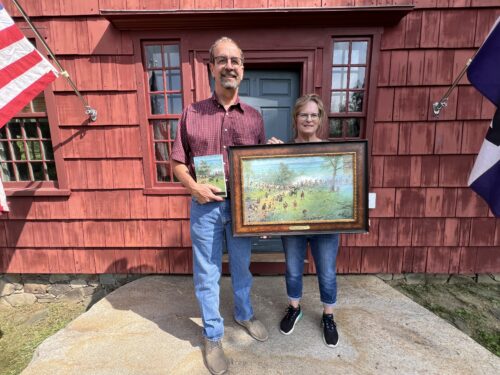
A native of Orwell, in Ohio’s Western Reserve (land in northeast Ohio once owned by Connecticut), Ken Lawrence commissioned renowned battlefield artist Dale Gallon of Gettysburg, Pa., to make a painting of the Battle of Ridgefield. The painting looks north toward the main engagement of the Battle of Ridgefield, where Patriots erected a barricade near present-day 563 Main Street to stop nearly 2,000 British troops returning to Long Island Sound after burning Danbury; the Stebbins House appears at right, near today’s Casagmo Condominiums. You can read more about the creation of this painting in an essay by Ken Lawrence below. Using Mr. Lawrence’s extensive historical research and other sources, Mr. Gallon created “Farmers Against the Crown,” which references Keith Marshall Jones III’s first book describing the Patriot response to the British invasion.
“Accurate and inspiring! I think the painting really captures the spirit of the event,” said Mr. Jones, who used a section of the painting for the cover image on his new book, The Battle of Ridgefield, Benedict Arnold, the Patriot Militia, and the Surprising 1777 Battle that Galvanized Revolutionary Connecticut.
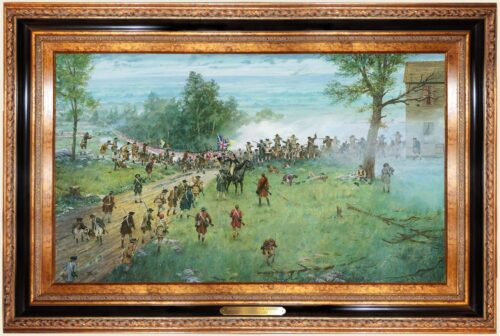
The original painting hangs in Mr. Lawrence’s home and prints, in various sizes on paper or giclée prints, are available for purchase from the Ridgefield Historical Society in association with Mr. Gallon here. A portion of each sale will benefit the mission of the Ridgefield Historical Society to preserve and share the history of Ridgefield.
Thanks to the generosity of Mr. Lawrence and his wife, Cheryl, a framed giclée print of “Farmers Against the Crown” is now part of the Ridgefield Historical Society collection and is proudly displayed at our Scott House headquarters at 4 Sunset Lane and can be viewed be viewed there before making a purchase.
For those who might be wondering, there is no specific figure in the Gallon painting that depicts Lt. Lawrence, but that is General Benedict Arnold on the horse, gesturing toward the Patriots’ left flank where British troops had climbed the ledges and were breaching the line.
For information, please contact [email protected] or call 203-438-5821.
Farmers Against the Crown
Painting by Dale Gallon
Essay by Ken Lawrence
Dale takes us back to a moment in time, Ridgefield, Connecticut, April 27th, 1777, at a barricade being fiercely defended by a quickly assembled Patriot militia against veteran British regulars. What brought us to this moment was a Redcoat disembarkment of 6 regiments, complete with artillery, on the Connecticut coast two days prior. Under cover of darkness and rain, Major General William Tryon led this raid into New England to destroy Patriot supplies in Danbury Connecticut. After completing their objective, they started back to their ships on a different route from which they came. Sir William Howe had sent a diversion up the Hudson River to keep Continental Troops away from this raiding force. He also placed some experienced Generals with the battle tested Redcoats. With all this careful planning, they did not expect the stubborn resistance that was forming to impede their return.
While the Redcoats were doing their work in Danbury, Patriot Generals David Wooster, Gold Sellick Silliman, and Benedict Arnold met on the 26th to plan a strategy to impede the Redcoats return. Gen. Wooster would take 300 of the estimated available 800 militia that were assembling to harass and slow the rear of the Redcoat column, achieving initial success on the 27th before his mortal wounding.
Continental Brigadier General Arnold would lead the militia, and a scant number of Continentals, at the Ridgefield barricade. He sent Lt Col Gould to lead the right flank. Arnold also deployed some militia to the left flank that was thought to be impenetrable by a rocky ledge faced by a swampy lowland.
The hastily built barricade blocked the road into Ridgefield and extended from Benjamin Stebbins’ (a Tory) house to an elevated area on the west side of the road. As there are no known highly detailed accounts of the barricade and the fighting, the artist has laid the central part of the barricade forward, to the “military crest” of the hill, giving us a better glimpse of the attacking Redcoats. With Arnold’s military experience this layout is very plausible. After an artillery barrage, the Redcoats attacked by column into the teeth of the barricade and simultaneously set out two separate flank attacks. Although outnumbered 3 to 1, Patriot forces stood at the barricade and fought with the urging & leadership of Arnold himself. This barricade would not be breached until after the flanks were turned, with Gould being killed on the right and the ledges being scaled on the left. The moment of time shown here is near the end of the fight at the barricade. Arnold will soon cross the road to help stem the Redcoat penetration on his left flank. A lost cause as his horse would succumb with 9 wounds & go down trapping Arnold momentarily. The Patriots withdrew in ragged haste, offering scattered resistance as they fell back thru Ridgefield. Although the Redcoat forces succeeded in their goal of destroying the Rebel supplies at Danbury, they failed in getting the citizens to turn out in mass to their support actuality it turned more of the citizenry to the Patriot cause. Due to this response of the militias of Fairfield County CT and Westchester County NY, the Redcoats would not venture another deep inland incursion into New England from the coast.
This piece was inspired by a descendent of Patriots at the barricade after reading Keith Marshall Jones III’s brilliant book FARMERS AGAINST THE CROWN. Keith graciously granted us the use of his title for this painting, of a moment in time, at the Ridgefield Barricade, on a windy Sunday afternoon. With Dale’s artistic gift, belief in this project, and dedication to historical accuracy this painting became a reality.