
Download PDF
Ridgefield in 1876: Celebrating the nation’s Centennial, Contending with ‘Centennial Burglars’
Ridgefield, Connecticut, in 1876 was a far different place than it had been in 1776: The town was becoming a summer refuge for city dwellers and its original settlers’ descendants had been joined by waves of immigrants looking for opportunities. While the town had lost population following the Civil War, the numbers began to grow again in the later 1870s.
The town had a new newspaper, founded in 1875 by D. Crosby Baxter as Baxter’s Monthly; the publication very soon evolved into the weekly Ridgefield Press. In 1876, most of the paper was “boilerplate,” news from all over the country, purchased by subscription and used to fill the spaces around advertising. Local news was limited to space on two or three pages.
The celebration of the 100th anniversary of the nation’s founding was naturally of interest to readers and Editor Baxter included many columns of material highlighting the 1876 Centennial Exposition in Philadelphia, which opened that summer.
The Ridgefield Skeletons
19th Century Ridgefield would be represented in Philadelphia in a fairly unusual way, but one that resonates with 21st Century Ridgefield.
Two years earlier, Ridgefielders had been taken back to the 18th Century and the 1777 Battle of Ridgefield when two skeletons were found in a sandbank off North Salem Road and were then determined to be “Hessian” soldiers (later scholarship has determined that the two were likely British troops). The skeletons were in the possession of Dr. Archibald Y. Paddock, a Main Street resident (who owned the sandbank), and he announced that they would be exhibited at the Centennial Exposition. Many years later, part of one of the skeletons was found in a hidden closet of the Paddock home when it was split in two and moved after the dentist’s death; the disposition of either skeleton is unknown.
(The four skeletons unearthed in Ridgefield in 2019, believed to also be Battle of Ridgefield combatants, are still making their way through forensic studies; they will eventually be returned to the town for a dignified burial.)
As the national centennial got underway, the March 15 Press included this ditty:
A Nursery Rhyme for 1876
Rock-a-by baby, on the treetop!
When the wind blows the cradle will rock.
But the cradle of liberty never will fal,
Though the boughs do wave and the tree is so tall.
It’s a simple contrivance, dear, having a spring,
That will hold you and rock you, as safe as a king;
You can see the whole world as your eyes grow strong —
The wonderful world that’s been growing so long,
That is wiser, my dear, and braver and truer
Each year as it grows. Of this we’re sure;
And this is why babies, in all times and lands,
Frolic and crow and toss up their hands.
A Growing Nation, a Changing Town
By 1876, many descendants of Ridgefield’s first settlers had moved west for better farming and business opportunities; the west was opening up and in the Centennial year, the 38th state, Colorado, would join the Union. A Ridgefielder, Peter Cornen, was among the oil wildcatters in western Pennsylvania who made their fortunes supplying the country’s burgeoning industries.
Railroads were connecting the country, with the first transcontinental line completed in 1869. The Danbury Norwalk Railroad had been in service since 1852 and in 1870 added a branch line into the center of Ridgefield, making travel a much easier process for townspeople and visitors.
And yet, 1876 America was still recovering from its Civil War (and was led by the great general of that war, Ulysses S. Grant, who was a year from the end of his second term as President). The frontier was still a contested area: Ridgefield Press readers learned in July 1876 of the deaths of Gen. George Custer and his 7th Cavalry in the June 25-26 Battle of the Little Bighorn in Montana territory.
While the Ridgefield woman suffrage movement was yet to formally organize, in 1876, the National Women’s Suffrage Association presented its modified version of the Declaration of Rights of Women, originally written in 1848 by Elizabeth Cady Stanton, Susan B. Anthony and Matilda Joslyn Gage at Seneca Falls, N.Y. The new document concluded, “we ask of our rulers for this hour no special favors, no special privileges, no special legislation. We ask justice, we ask equality, we ask that all the civil and political rights that belong to citizens of the United States be guaranteed to us and our daughters forever.”
Sharing History
The Ridgefield Press carried no mention of the women’s declaration, but throughout the Centennial year continued to publish short articles that touched on Revolutionary War history. These included an account from General George Washington’s “Orderly Book,” which told of the treason of Benedict Arnold and the execution of Major John Andre. The story failed to mention Arnold’s role in the Battle of Ridgefield or the fact that a Ridgefielder (Lt. Joshua King) escorted Major Andre to his execution. History was on the minds of Ridgefielders during the Centennial: A state legislature resolution recommended that each town in the state prepare a Revolutionary and Centennial history. Ridgefield Town Clerk Hiram K. Scott (also Judge of Probate and former state legislator) posted a notice in the Ridgefield Press inviting “all citizens who feel an interest in such a history to meet at the Town Hall on Friday evening, July 8th, at 8 o’clock, for the purpose of selecting some suitable person to prepare a history of Ridgefield from the first settlement in 1708 to the present time.”
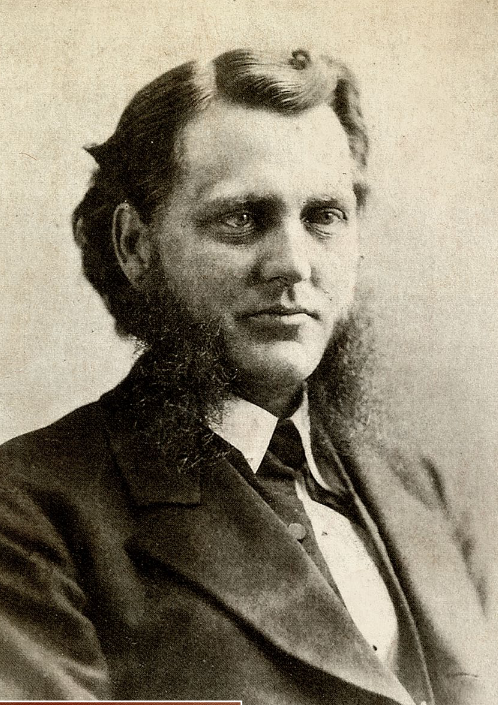
Within two years, the Rev. Daniel W. Teller, minister of the First Congregational Church, had produced the first formal town history, the 238- page History of Ridgefield. The Rev. Teller, who served here from 1872 to 1880, was evidently devoted to the town and its history. Although he was a native of Yorktown, N.Y., and served a parish in New Haven after Ridgefield, he chose to be buried here, in Scott’s Cemetery.
The Centennial Exposition
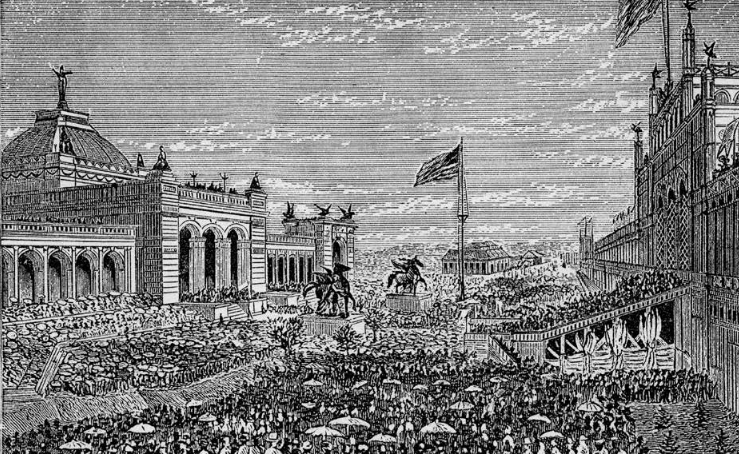
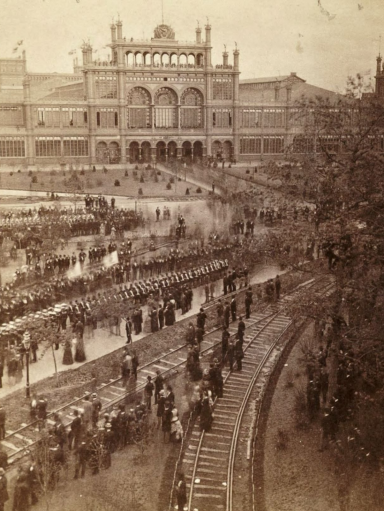
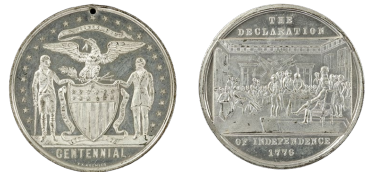
The Centennial International Exhibition, officially the International Exhibition of Arts, Manufacturers and Products of the Soil and Mine, opened in Philadelphia on May 10 and ran through Nov. 10, 1876, in Fairmount Park. Nearly 10 million visitors were reported and 37 countries participated.
Ridgefielders were among the visitors, their excursions often noted in The Press, which wrote in September: “Many of our people have already been, and others are going, to visit the Centennial Exhibition at Philadelphia. Last week the Rev. D.D. Bishop and wife, E.J. Couch and others went, and last Monday’s trains took W.O. Seymour and wife (he was then chief engineer of the New York, New Haven and Hartford Railroad), E.L. Smith and sister, Dr. Todd and wife, L.C. Seymour and wife, D. Smith Sholes, Simon Couch, Miss Julia Hurlbutt and Miss Faustina Hurlbutt – all for the same destination.” There had been a major heat wave in Philadelphia during the summer, and many Ridgefielders seem to have chosen to wait for more temperate weather to visit.
The Press reported that “Cheap fares to the Centennial Exhibition at Philadelphia are the order of the day in all parts of the country. Tickets are sold on board the steamer Arrowsmith for the round trip from South Norwalk, by way of that boat to New York, thence by the Central Railroad of New Jersey to Philadelphia, and return the same way, for the low price of $3.50.” (That would be about $100 in 2026 dollars, likely beyond the means of many in Ridgefield at the time.)
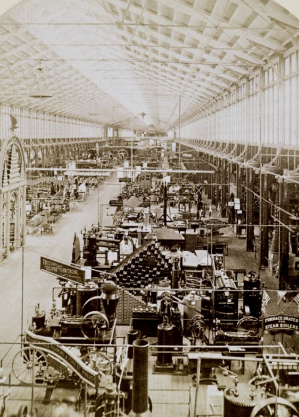
The visitors would find much to see in the Main Exhibition Building, then the largest building in the world, encompassing 21.5 acres. In addition there were numerous other buildings on the site as well as temporary hotels to accommodate those who traveled to the Exposition. There was a Women’s Pavilion, built by women, with exhibits created and operated by women.
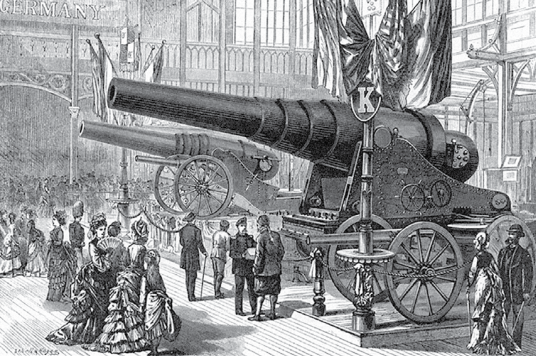
Among the consumer products first displayed at the Exposition were Alexander Graham Bell’s telephone, the Sholes and Glidden typewriter (Remington No. 1), Heinz Ketchup, and Hires Root Beer. John A. Roebling & Sons showed a slice of their nearly six-inch cable to be used for the Brooklyn Bridge.
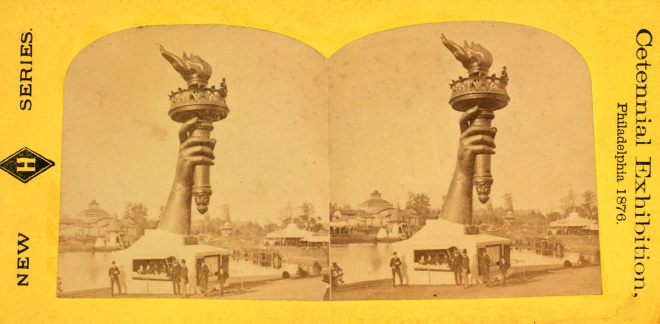
Ridgefield visitors were undoubtedly impressed by the exhibit of the right arm and torch of the Statue of Liberty, in which, for a fee of 50 cents, they could climb the ladder to the balcony. Proceeds helped pay for the pedestal of the statue at its permanent home in New York Harbor.
‘Centennial Burglars’
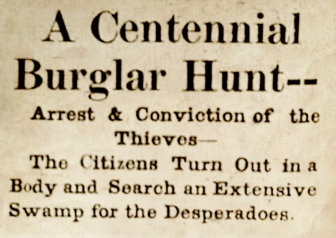
Meanwhile, back in Ridgefield, the Centennial year was proving to be a trying time for townspeople: The Press reported, “For several years our village has suffered severely from burglars. Houses were entered both day and night and robbed.” An Anti- Thieving Association had been formed and arrests of some of the alleged culprits were finally made, but two of the family were still on the loose.
The situation led to the unusual scene which unfolded in late July, 1876, when “nearly every able-bodied man” in Ridgefield responded to a call from Ridgefield Constable John Gilbert to mount a massive search of Silver Spring Swamp for the two burglars who were brothers and believed still hiding out there.
“Guns were aplenty, pistols numerous,” The Press said. “It was a motley but courageous crowd.”
However, when the hunters emerged from the swamp near sunset, The Press reported, “no one had discovered the slightest trace of the thieves. Our ‘chosen brave’ were in a pitiful plight. Some of them had been immersed in slough holes, others had been lacerated by briars and thorns.”
The Ridgefield posse reassembled a couple of days later, when it was promised that a family member would call the two “desperadoes” out of the swamp. The anti-thieving crowd was again disappointed. (Eventually, after yet a third futile search of the swamp by 300-400 volunteers, the two were captured in the Hudson Valley; one of them was turned in by another brother, in exchange for the promised $50 reward.) The burgling brothers and their father were sent off to prison in Wethersfield and the crime wave ended. Many stolen items were recovered at the family homestead and returned to their owners.
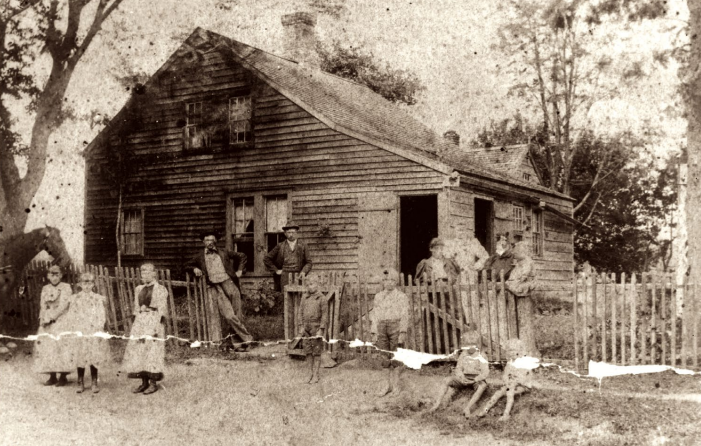
One hundred years after the founding of the United States of America, Ridgefield had changed in many ways, but it remained a place where neighbors helped each other and several hundred men turned out to spend a July day searching a swamp for a pair of homegrown “desperadoes.” The story of the “Centennial Burglars” gradually faded from memory.
One hundred and fifty years later, the family home of those burglars still stands on Silver Spring Road and the swamp behind it is largely undisturbed, home to a wide array of wildlife, with much of the land preserved as open space.
Ridgefield in 2026 remains a place where neighbors help neighbors and the many visitors to the town appreciate its natural beauty and the history that surrounds it.