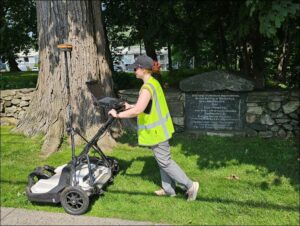
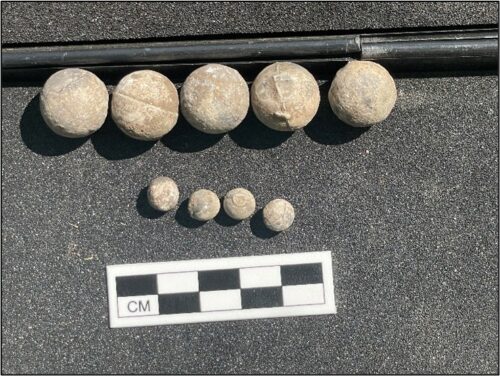
This summer the Heritage Consultants archaeologists found a substantial number of military artifacts in one concentrated area close to where the Battle of Ridgefield began to subside. Among the items found were two Continental Army buttons with “USA” engraved on the front. A few feet away from one of them, five .65 diameter musket balls and four .30 diameter balls were found lying together beneath the ground. (The measurement refers to fractions of an inch, ‘so .65 is 65 percent of an inch.)
The musket balls were probably carried by an American soldier as ammunition for his Charleville musket, the most common firearm used by American troops. The smaller balls were buckshot and would have been loaded into a musket with one large ball. The result was called a “buck and ball” load and its effect was to combine the impact of a musket ball with the wide pattern of buckshot. Soldiers could hit a formation of troops 150 yards away with a buck and ball.

A Revolutionary War era Charleville musket carried by American forces.
In General Orders dated June 29, 1776, Washington officially ordered the Continental Army to use buck and ball loads. “The General expects that all Soldiers, who are instrusted [sic] with the defence [sic] of any work, will behave with great coolness and bravery and will be particularly careful not to throw away their fire – he recommends to them to load for their first fire, with one musket ball and four or eight buck shot, according to the size and strength of their pieces; if the enemy is received with such a fire at not more than twenty or thirty yards distance, he has no doubt of their being repulsed.”

We use digital calipers to measure the diameter of musket balls in the field.
Soldiers at the time of the battle used leather shot-bags with straps to hold their buck and ball. Most of the ones found this summer were smooth and still had marks on them from their casting, indicating they were never fired. It’s possible that an entire shot-bag of unused ammunition had been dropped by a soldier who was either trying to reload his musket or fleeing from the British to higher ground. Near the musket balls were two balls that are deformed, meaning they’d been fired by soldiers passing through the location. The state of the impacted balls is compelling evidence that a skirmish took place in that location.
Although it’s impossible to know exactly what happened there, the artifacts give us a rare insight into one American soldier’s actions during what was probably an extremely intense moment in the battle.
The Battle of Ridgefield archaeological project, funded by a National Park Service grant, is a project of the Ridgefield Historical Society, with Heritage Consultants LLC, the professional team charged with exploring and documenting evidence of the battle’s boundaries, engagements and participants. A first phase of this effort was completed in 2022, when documentation and mapping were undertaken. Now, hands-on archaeological work is the primary focus of the team, which has been working at a variety of locations throughout the battlefield area. Monthly blog posts by the archaeologists provide updates on discoveries.